
We don’t like to talk about it… really, truly hate to even consider using pesticides. I feel about pesticides like I feel about guns (yes, controversial topic; nope, don’t want to get into it) – they are a tool that we should all fear enough that we learn to use them properly, with caution, and extreme restriction.
I bring this up now because the last two weeks have been a crash course on pesticides for me. I won’t get into all the gory details here (shoot me an e-mail if you’re wrestling with a particular problem), but what I learned is that the science is complicated and often unclear for the laymen, and, furthermore, there is a lot of folklore on the subject that isn’t always helpful.
Now I write this post NOT as an expert but as a mindful user. The information below is compiled from conversations with IPM (integrated pest management) experts, pesticide suppliers, people in research and development, and the odd scientific journal article. I am happy to make corrections where they are due.
THE OLD DOGS PLAYING NEW TRICKS
In the world of pesticides there are the old grandpa chemicals that used to be widely used and are now either banned or have developed a very bad reputation. Among these are pesticides like organophosphates and organochlorines.
Organochlorines, well, they really really deserve their bad name. They are non-target insecticides the most prominent of which you’ll probably recognize – DDT. They are hydrophobic and have a very long half life. So… well, safe to say they are all banned in countries that are wealthy enough to put in that type of legislation.
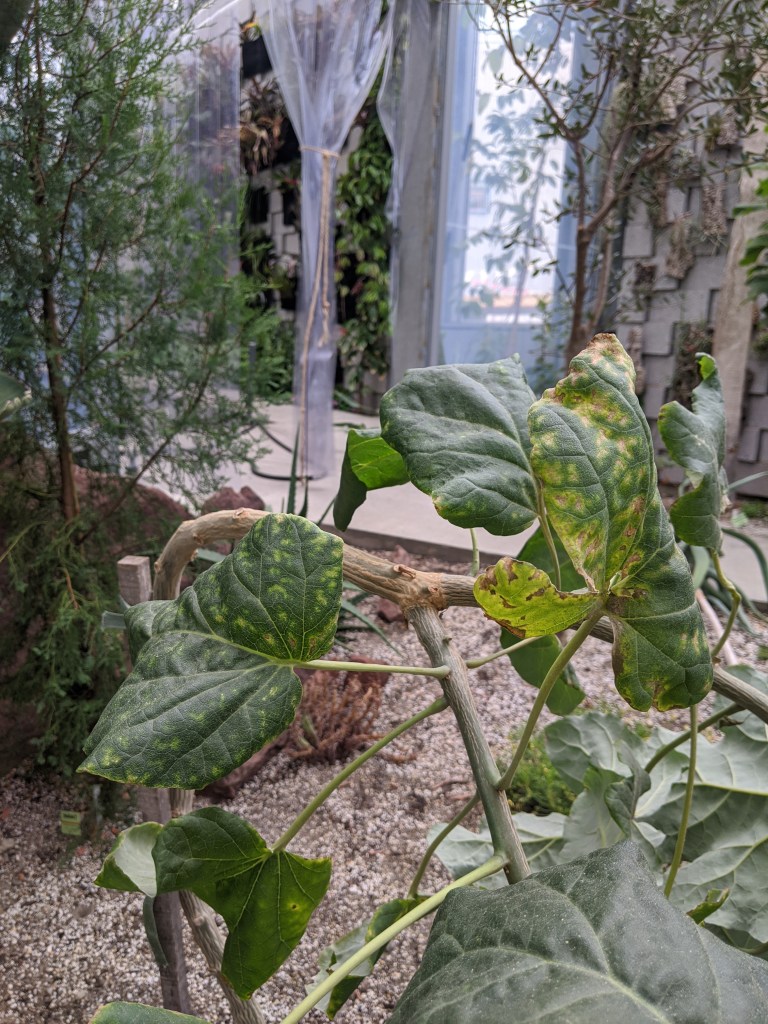
I had to wrestle with organophosphates over the last couple of weeks. They carry a really bad wrap. Like organochlorines, these are a systemic pesticide (it will travel through at least part of the plant; in this case these systemics travel through most of the plant with some exceptions including new growth). They get their bad name because their mode of action affects vertebrates… you know, like humans. But I was attracted to them because, for a systemic, they have a really short half life (they dissipate in the environment within days) and get broken down by microbes. It should, just like other pesticides, not be messed with casually. However, in some applications, such as a soil drench, this pesticide is quite a useful one. New formulations of organophosphates like acephate are less likely to be aerosolized and therefore solve some of the issues. Containment is key for this old dog learning new tricks.
NEW COOL KIDS WITH DOWNSIDES
Neonicotinoids have had a front row seat in environmental news for their effect on pollinators. In truth, there is a negative effect on pollinators from almost every pesticide. Yes, again, this group of pesticides just like others have serious negative effects. The key is to understand them. The reason neonics took the spotlight from organophosphates as the systemic pesticide of choice is that it has a mode of action that does not affect vertebrates. Another upside to their use as a systemic is their long half life in the soil, making it persistent for longer periods and therefore decreasing the amount of times you must apply them.
But hold up. Is persistence in the soil a good thing? Well, in many cases, no. Sure, when your application is isolated, like in a potted plant (inside a home that does not have to be concerned about hurting the good bugs), that can be a very desirable trait. Imidocloprid is sold on the shelves of Home Depot for anybody to purchase as a pesticide that’s safe for your home… or something. But outdoors, where that pesticide can remain, if not taken up by the plant, for many years this can be of serious detriment. In fact, most studies have shown that neonics don’t have an abnormally high effect on pollinators. It is their persistence and re-uptake by non-target plants that causes many of the problems.
Neonics have their place. They must be isolated, used only when absolutely necessary (in my opinion), and researched thoroughly. For example, 4D action neonics are safe for both pollinators and most beneficial insects (those that feed on pests). Many have a much shorter half life in the soil as well.

“SAFE” PESTICIDES
We all read that horticulture oils like neem oil is the sustainable method of pest management/removal. It is a great method. However, because of all the positive press around it, we all collectively forget that it is actively killing insects on the plant. So, here is my small PSA. Hort oils are still dangerous! They will kill anything they lay in contact with. They are also phototoxic, meaning that when in contact with direct light they will burn the plant.

So, first know what you’re spraying. Avoid your friendly spiders and predatory wasps. Second, spray early in the morning or at dusk when the sun is low, it is cool, and there is a nice breeze coming through guaranteeing a fast dry-out.
FINAL WORD
The living ecosystem is complicated. There are no simple answers and every action has a reaction. It is very easy to get looped in and turned around to be spat out of your research feeling like you know less than when you started. Every pest has a life cycle which may be one week long or one year long. They interact with each other. They prefer different parts of the plant. Some fly, some crawl. You have to know what you’re looking at or, rather, ask someone.
My recommendation is scout often – if you find them early, you can simply mechanically remove them (yes, I do mean just wipe that scale off), and do isolated treatments (such as a hort oil). There’s a level of pests you may just want to live with. The density of many pests has to reach a critical mass before the plant significantly declines. And finally, keep the plant healthy. A healthy plant is much less likely to succumb to pests, pathogens, etc.

Happy growing everyone!
 Green Your Thumb
I always try to make customers see the bigger picture, like are they and their convenience really more important than other life. I’d rather propose to them planting something that helps attract beneficial insects, or diversify their garden ecosystem. Lately we’ve been having huge problems with Cydalima perspectalis, a moth that lays it’s eggs in the well known Buxus sempervirens. The caterpillars then proceed to destroy the boxwood entirely. Instead of spraying I’ve been able to convince most people to replace their Buxus with Ilex crenata, which is similar looking, just as hardy, and is not bothered by Cydalima. Small victories, but it’s a thin line to walk sometimes, trying to educate people and change their minds without being or seeming rude.
What is your opinion on diatomaceous earth as a pesticide? I see that product hailed all the time in permaculture forums and video’s.
LikeLike
I’m happy to say that boxwoods are slowly becoming a thing of the past in northeastern nurseries and there is a lot of popular literature to dissuade people from planting them. It is a similar story to roses-cut your inputs by cutting the plants.
I manage a conservatory so unfortunately, when things get really out of hand there is no way around a pesticide. However, I always consider the merit of a plant of it is a pest magnet.
I’m careful and diatomaceous earth. I would now likely recommend an iron phosphate bait than that. Slugs force us to get creative and really think small, but I don’t count applying diatomaceous earth as a sustainable response. Again, I think with that product isolation is key.
LikeLike